Paris
All the Light We Cannot SeeParis frames two very different periods of Marie-Laure LeBlanc’s life: the city where she learns to move through the world as her sight fails, and the city whose wartime upheaval separates her from her father. The Paris Natural History Museum binds these periods together. It is Daniel LeBlanc’s workplace, the destination of their daily journeys, a threatened repository of collections, and eventually the setting of Marie-Laure’s scientific career.
City and Museum in Marie-Laure’s Childhood
At six, Marie-Laure lives in Paris with rapidly deteriorating eyesight. Her father brings her to the Paris Natural History Museum, where he works, and sends her on a children’s tour. The guide, a hunchbacked warder scarcely taller than the children, raps his cane against the floor to gather the group before leading its dozen members across the gardens and into the galleries. The museum introduces Paris to Marie-Laure not simply as a city to be seen, but as a place crossed through sound, movement, touch, and familiar routes.
When the tour ends, the children disperse and Marie-Laure returns to the Grand Gallery with Daniel. He straightens her glasses and plucks a leaf from her hair, small gestures that make the museum feel at once like a workplace and an extension of family life. Her connection to the institution is practical as well as intimate: she accompanies her father there, and its rooms become part of the ordinary geography of her childhood.
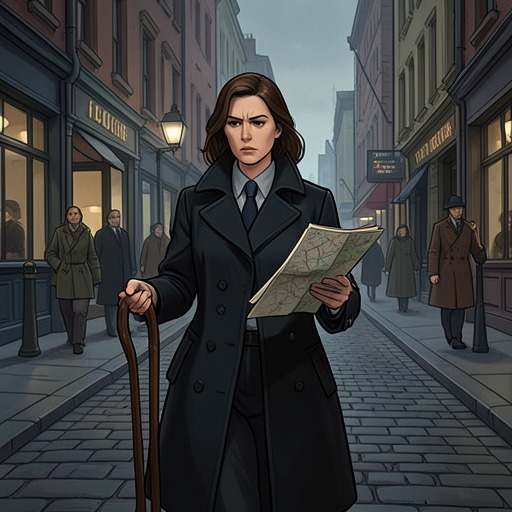
That geography is measured in steps and repeated journeys. At six forty, Marie-Laure collects her white cane from the corner, hooks a finger through the back of Daniel’s belt, and follows him down three flights of stairs and six blocks to the museum. The routine gives concrete form to her growing independence while also showing how closely it depends on a route she knows and on her father’s steady presence. Paris is rendered at the scale of the walk: home, stairs, blocks, and the museum entrance.
The city also appears through Daniel’s work as principal locksmith at the museum. Its many keys are part of his ordinary professional world, and his skill in locks later becomes one of the facts through which others try to understand his loyalty and his family. In wartime, the same expertise takes on a sharper significance: the safeguarding of collections depends on secure rooms, locks, keys, and controlled access.
The Museum Under Threat
As war approaches, the museum’s daily work changes into a system of protection and transfer. Memos announce that collections must be safeguarded; couriers begin moving objects to country estates, and locks and keys become more urgently needed. Daniel works until midnight or later, ensuring that crates are padlocked and transport manifests kept secure. Armored trucks arrive at the loading docks. Fossils and ancient manuscripts are among the objects to be protected, alongside a thirteenth-century jade, cavansite from India, rhodochrosite from Colorado, pearls, gold nuggets, and a sapphire described as being as large as a mouse. For Marie-Laure, the inventory also raises the possibility that the Sea of Flames is among the endangered treasures.
The diamond’s security is complicated by the making of decoys. The museum director’s plan calls for three replicas in addition to the real stone: one remains at the museum, while three stones are assigned separate routes. One travels south with a young geologist, another north with the chief of security, and one is carried in Daniel’s tool case in a field west of Versailles. The distribution turns the museum’s protection effort into a problem of provenance and uncertainty: the real diamond and the replicas are deliberately difficult to distinguish by their whereabouts alone.
The replicas themselves do not settle that uncertainty. In the two months before the invasion of France, Dupont makes three copies using a casting; he has never seen the real diamond. Reinhold von Rumpel, a gemologist who had once run an appraisal business in Stuttgart, believes him. The distinction between an object and its copy matters in Paris because the museum’s records, the routes of its couriers, and the knowledge of those who handled the stones all become part of the search. What can be known about the diamond is shaped as much by its custodians and its movements as by its appearance.
Von Rumpel’s pursuit leads into the museum’s secured interior. A small locked door at the rear of a main-floor gallery requires two keys. Beyond it, a corkscrewing stone staircase and a second locked gate lead through corridors to an unassuming storeroom of dropcloths, pallets, and crates. Behind plywood sits a combination safe, which the assistant director opens. The route makes the museum’s architecture part of the struggle over access: the hidden object is reached through layers of locks, passageways, and institutional control, even as those safeguards prove penetrable to a determined searcher.
Departure and Separation
Paris’s breakdown is felt in the crowd trying to leave. By one in the morning, the gates are still pressed with people, the gendarmes have lost control, and no train has arrived or departed for more than four hours. Marie-Laure sleeps on her father’s shoulder while the locksmith listens for the whistles and coupling noises that never come. At dawn, with the trains still absent, he decides it is better to continue on foot. The failed timetable turns a planned journey into an uncertain departure, and the crowd makes the city’s emergency a shared experience rather than a private family choice.
Daniel later buys a single-passenger ticket on a morning train to Rennes and then on to Paris. He walks back through narrow, sunless streets toward rue Vauborel, intending to return to work, staff the key pound, and lock things away before riding back to Brittany in a week to collect Marie-Laure. The plan holds separation and reunion together: Paris remains the point to which he expects to return for his work, while Brittany is where he has left his daughter. But the museum reports to Etienne LeBlanc that Daniel never arrived. The intended short absence becomes an unresolved loss.
The effects of that absence are visible in Marie-Laure’s life away from Paris. On the twentieth morning without news, she stays in bed. She stops asking Madame Manec to take her to the station, write another letter, or spend another afternoon petitioning the occupation authorities to find her father. She becomes unreachable, neglects washing and food, and withdraws from the kitchen fire and the outdoors. Madame Manec tells her that the museum says it is searching, but the reassurance cannot overcome the report that Daniel never reached Paris. The city, once the destination of their daily walk, now marks the interrupted route between father and daughter.
Wartime Paris and the Search
Paris also becomes a city of scarcity and altered habits in the accounts carried to Saint-Malo. Madame Manec’s friends describe queues lasting five hours for bread, people eating pets, and pigeons killed for soup; they report that pork, rabbit, and cauliflower are unavailable. Car headlights are painted blue, and at night the city is described as nearly silent, with no buses or trains and scarcely any gasoline. These details reach Marie-Laure at a square kitchen table with a plate of cookies before her. The contrast between the food in front of her and the deprivation described by the visitors connects distant Paris to her present life without making the city’s hardship abstract.
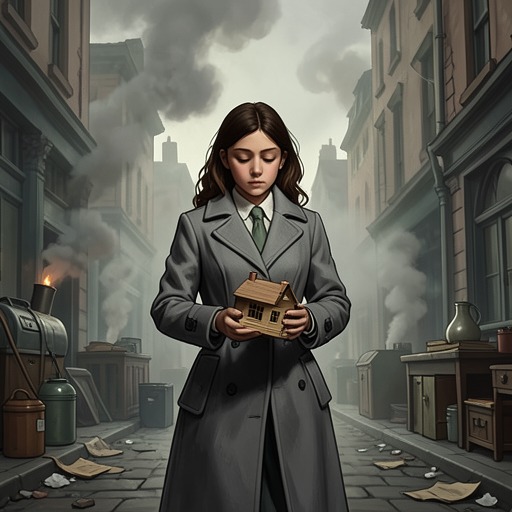
The city’s streets and buildings remain part of von Rumpel’s investigation. At an apartment house on rue des Patriarches, he offers ration tickets to the landlady, who takes them and hides them in her housecoat. He finds a workbench furnished with tiny benches, lampposts, polished wooden forms, nails, and glue, beside a detailed Paris Fifth Arrondissement Model. Its shutters, doors, windows, and storm drains are carefully made, but it contains no people. The model gives von Rumpel a new clue: its maker is a safe maker, brilliant with locks, employed at the museum throughout his adult life, and living within walking distance of it. The fact that Daniel has a blind daughter appears to von Rumpel as a possible reason for loyalty. In Paris, the model converts streets and buildings into evidence in a search directed toward a person and, ultimately, toward the missing stone.
Return to Paris
The city is not only a place of childhood and wartime pursuit. Marie-Laure later manages a small laboratory at the Paris Natural History Museum and contributes to the study of mollusks. Her work includes a monograph on the evolutionary rationale for folds in West African cancellate nutmeg shells, a frequently cited paper on sexual dimorphism in Caribbean volutes, and the naming of two new chiton subspecies. As a doctoral student, she travels to Bora Bora and Bimini, wades onto reefs, and collects snails on three continents. The girl who once followed her father through Paris to the museum has become a scientist whose research takes her far beyond the city, while the institution remains the center of her professional life.
One Wednesday evening in July, an assistant quietly announces a woman visitor to Marie-Laure’s laboratory. Tanks bubble, filters hum, and aquarium heaters click on or off as Marie-Laure keeps both hands on the keys of her Braille typewriter. She wonders whether the visitor is a collector. In their meeting, she remarks that the woman learned French as a child; elsewhere in the encounter, Marie-Laure whispers Werner’s name aloud. Paris thus holds a later meeting shaped by histories that began elsewhere, and the museum laboratory—once the destination of a child’s daily walk—becomes the setting in which old connections can return.
Paris’s narrative significance rests on these overlapping functions rather than on a single view of the city. Its streets provide the measurable route of Marie-Laure’s childhood; its museum supplies Daniel’s work and the machinery of wartime protection; its failing transport system exposes the scale of departure; and its modelled districts become clues in von Rumpel’s pursuit. Later, the same museum shelters Marie-Laure’s scientific vocation. Across those changes, Paris is at once a lived environment, a storehouse of objects, and a map of separations and returns.